
From Structured Data to AI: Insights from the NORTH Link AI Summit 2026
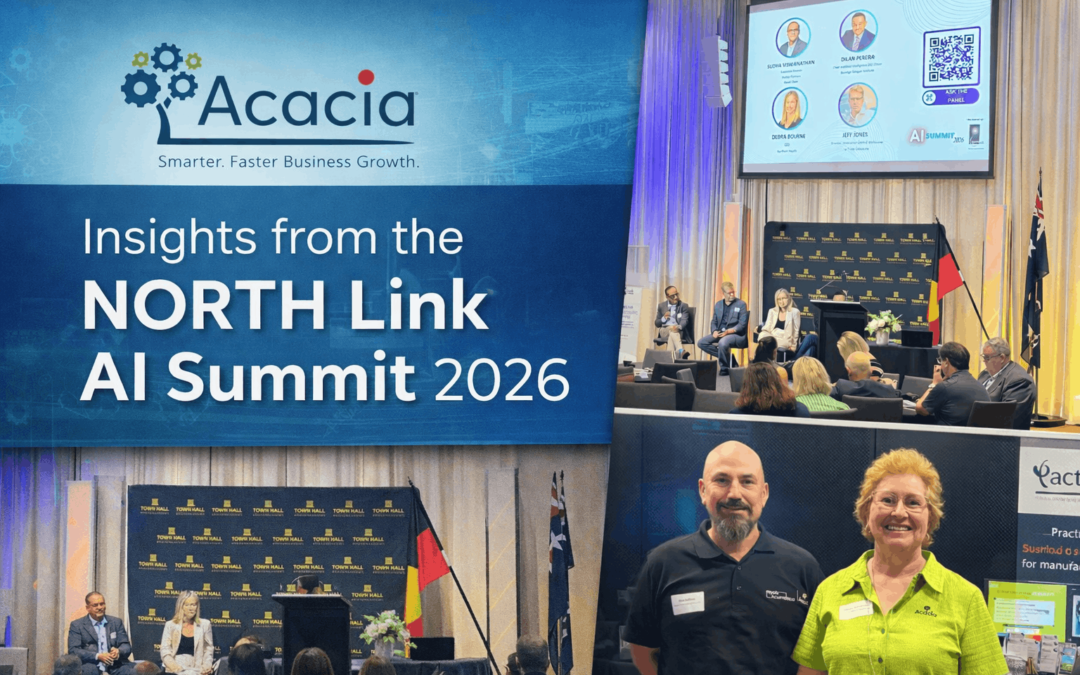
At the recent NORTH Link AI Summit 2026, held in Broadmeadows, Melbourne, the conversation was clear: artificial intelligence is no longer a future concept, it is a present-day business imperative. The event brought together business leaders, researchers, and technology providers to explore how SMEs can practically adopt AI to drive growth, efficiency, and innovation.
As exhibitors, Acacia Consultancy Services had the opportunity to engage directly with businesses navigating this transformation, and one theme consistently emerged:
AI success starts with structured data.
The Real Starting Point: Structured Data
Many organizations are eager to implement AI, but the foundation is often overlooked. Without clean, structured, and well-governed data, even the most advanced AI tools fail to deliver meaningful outcomes.
ERP systems play a critical role here. They act as the single source of truth, ensuring that financial, operational, and customer data is consistent, reliable, and accessible.
At the summit, discussions around data governance, ethics, and responsible AI reinforced this point, businesses must first “make sense” of their data before they can unlock AI-driven value.
From Structure to Automation
Once data is structured, the next step is automation.
Automation bridges the gap between static systems and intelligent decision-making. It allows businesses to:
• Streamline workflows
• Eliminate manual processes
• Improve accuracy and reporting
• Scale operations without increasing overhead
In our conversations at the summit, many SMEs were still heavily reliant on manual processes, spreadsheets, disconnected systems, and siloed data. These environments create friction and limit the ability to adopt AI effectively.
Automation, powered by well-implemented Enterprise Resource Planning (ERP) Business Platforms, becomes the enabler preparing businesses for the next phase.
AI as the Outcome, Not the Starting Point
The summit focused heavily on practical AI adoption, emphasising tools, use cases, and pathways for SMEs to get started.
However, what became evident is that AI should not be treated as a standalone initiative.
AI is most powerful when it is:
• Built on structured, high-quality data
• Integrated into existing business systems
• Aligned with clear operational goals
In other words, AI is the outcome of a well-executed digital transformation strategy, not the first step.
What We Heard from the Attendees
Engaging with attendees, a few consistent challenges stood out:
• “We have data, but it’s not connected.”
• “We want AI, but don’t know where to start.”
• “Our systems don’t talk to each other.”
These challenges reinforce the need for a phased approach:
1. Structure your data (Using ERP as your foundation)
2. Automate your processes
3. Layer in AI for intelligence and prediction
4. Start with something small to get your confidence
As Dianne Semmens, Managing Director of Acacia Consultancy Services, puts it:
“AI is not a silver bullet. Businesses that succeed are the ones that invest in getting their data and systems right first because that’s what enables automation, and ultimately, meaningful AI.”
Moving Forward: A Practical Path for SMEs
Events like the NORTH Link AI Summit highlight a critical shift, SMEs are ready to adopt AI but need clarity on how.
The pathway is not complex, but it requires discipline:
• Start with systems
• Focus on data integrity
• Enable automation
• Then scale with AI
At Acacia Consultancy Services, this is the journey we help organisations navigate from foundational ERP implementation through to intelligent, AI-enabled operations.
In Summary
The future of business is not just AI-driven,
it is data-driven, system-enabled, and automation-led.
And for SMEs, the opportunity is significant: those who get the foundations right today will be the ones who scale, compete, and lead tomorrow.